Yes, there are still layoffs.
Even as AI accelerates productivity and opens new markets and opportunities, thousands of jobs are disappearing every month. Tech, retail, manufacturing, logistics – no sector is immune. And yet as we’ve discussed here before, earnings reports still shine. So what exactly is happening?
Every major technological leap has followed this same pattern: invention, human augmentation, efficiency, displacement, reinvention. The curve is as old as industrialization itself. What’s different this time is how steep this curve has become.
According to Challenger, Gray & Christmas, “It’s very likely job-cut plans are going to surpass a million for the first time since 2020.” (September 2025 Report) That data reflects a structural reset in how labor is being deployed across industries.
And just this week, Amazon announced another wave of restructuring, signaling plans to automate up to 75 % of its U.S. warehouse operations by 2027. This move is projected to eliminate or repurpose more than 160,000 jobs. The company is also reducing headcount across HR and administrative divisions as it reallocates resources to AI infrastructure and automation systems.
So yes, a material percentage of jobs are going away due to technology innovation. But, this isn’t the first time this has happened.
The Compression of the Curve
When the steam engine replaced manual labor, the adjustment period lasted decades. Workers could retrain, industries could expand, and economies had time to absorb the change. Even the introduction of the personal computer gave us a generation to reskill.
But with AI, the cycle of “invention → efficiency” is measured in quarters, not decades. We’re watching the full arc of technological maturity, from early usability gaps filled by people to full automation, happen inside a single planning horizon.
The ongoing waves of layoffs timed to shifting investments and earnings reports that we’re seeing now a signal that the experimentation phase is ending in waves. Companies are moving from OpEx-heavy innovation to CapEx-heavy optimization – from “hire and build to explore” to “consolidate and build to scale.”
The Workforce Utilization Curve
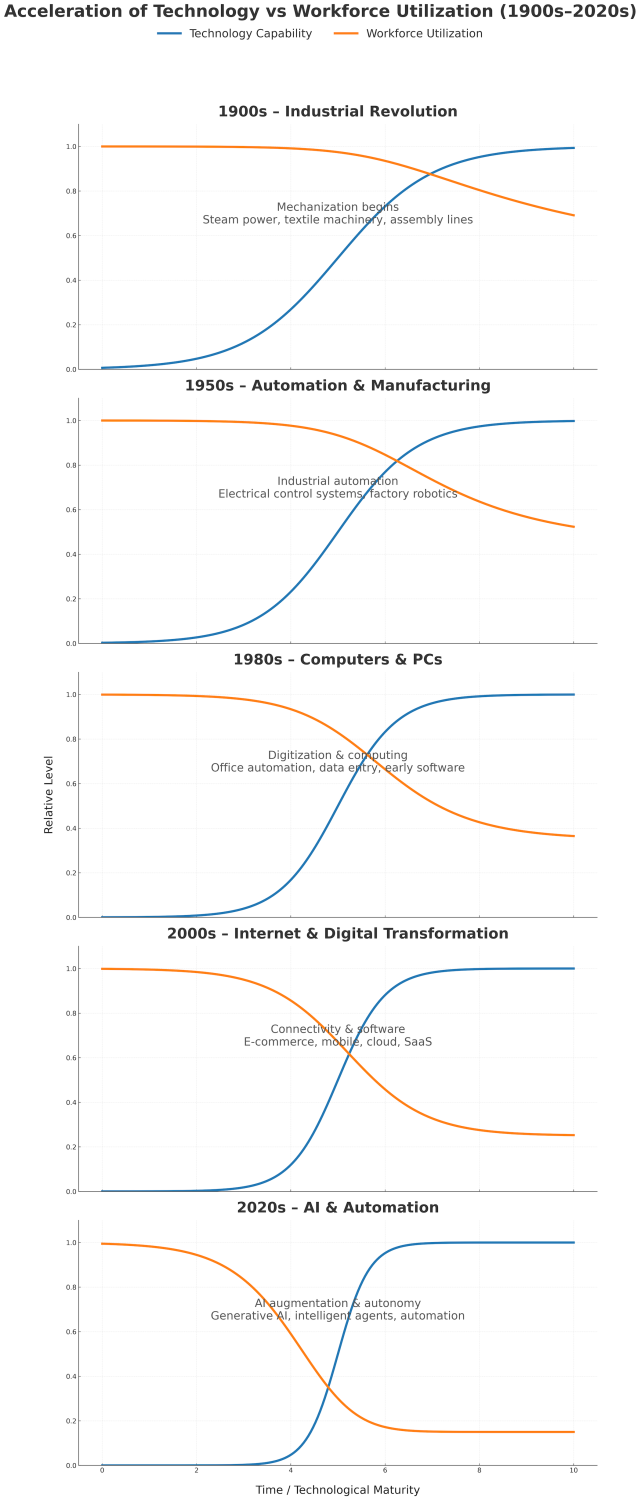
Every technology wave since the Industrial Revolution has followed a similar rhythm between how fast technology matures and how humans were deployed to make everything work. The orange curve illustrates how human capital is leveraged as time goes on through each period of technology innovation. In the early stages, the tech is novel but clumsy. People step in to train, troubleshoot, and stabilize it. Technology plays a role, but a specific one in the human workflow.
As time passes, the blue curve, representing technology capability, catches up and eventually surpasses the human one. Processes harden. Interfaces improve. Code replaces coordination. The orange line falls not because people stop mattering, but because systems start scaling in a way that does not require as much human capital to complete the same tasks.
Across history, this relationship has compressed dramatically. What once took fifty years (like industrial mechanization) now takes five (like generative AI). Today, the plateau of human reliance has been replaced by a steep, short spike.
The Emergence of New Industries and Economic Expansion
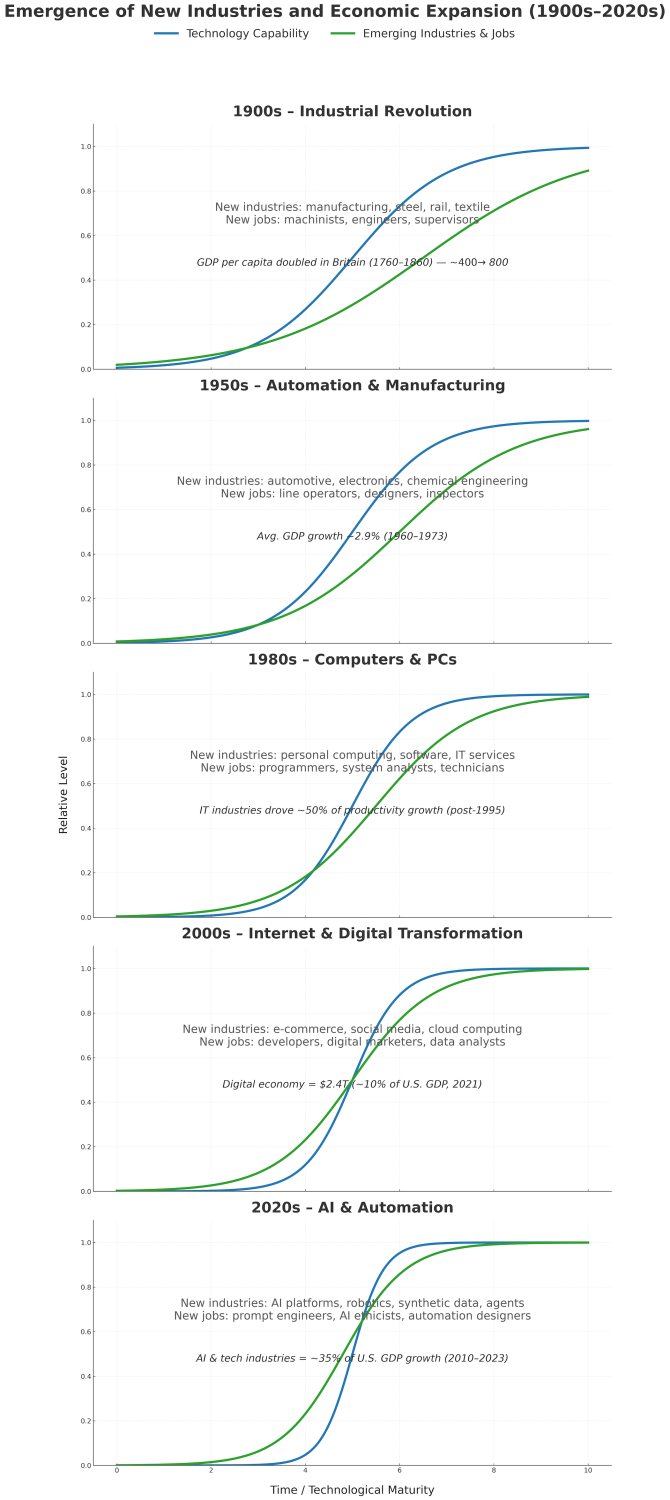
These technology leaps have not only changed how we work and what we work on, but it also created entirely new categories of work. Manufacturing, computing, e-commerce, and now AI platforms each followed the same path: innovation, displacement, expansion. The green curve in the chart above shows how every wave ultimately birthed new industries and GDP growth – from the Industrial Revolution through the digital and AI eras. The rate of new job and category creation too has accelerated over the years.
But, this recovery isn’t instant and economic value catches up only after new jobs and categories are created and the workforce adapts, and that lag is what we feel as disruption.
The Gap Between Displacement and Creation
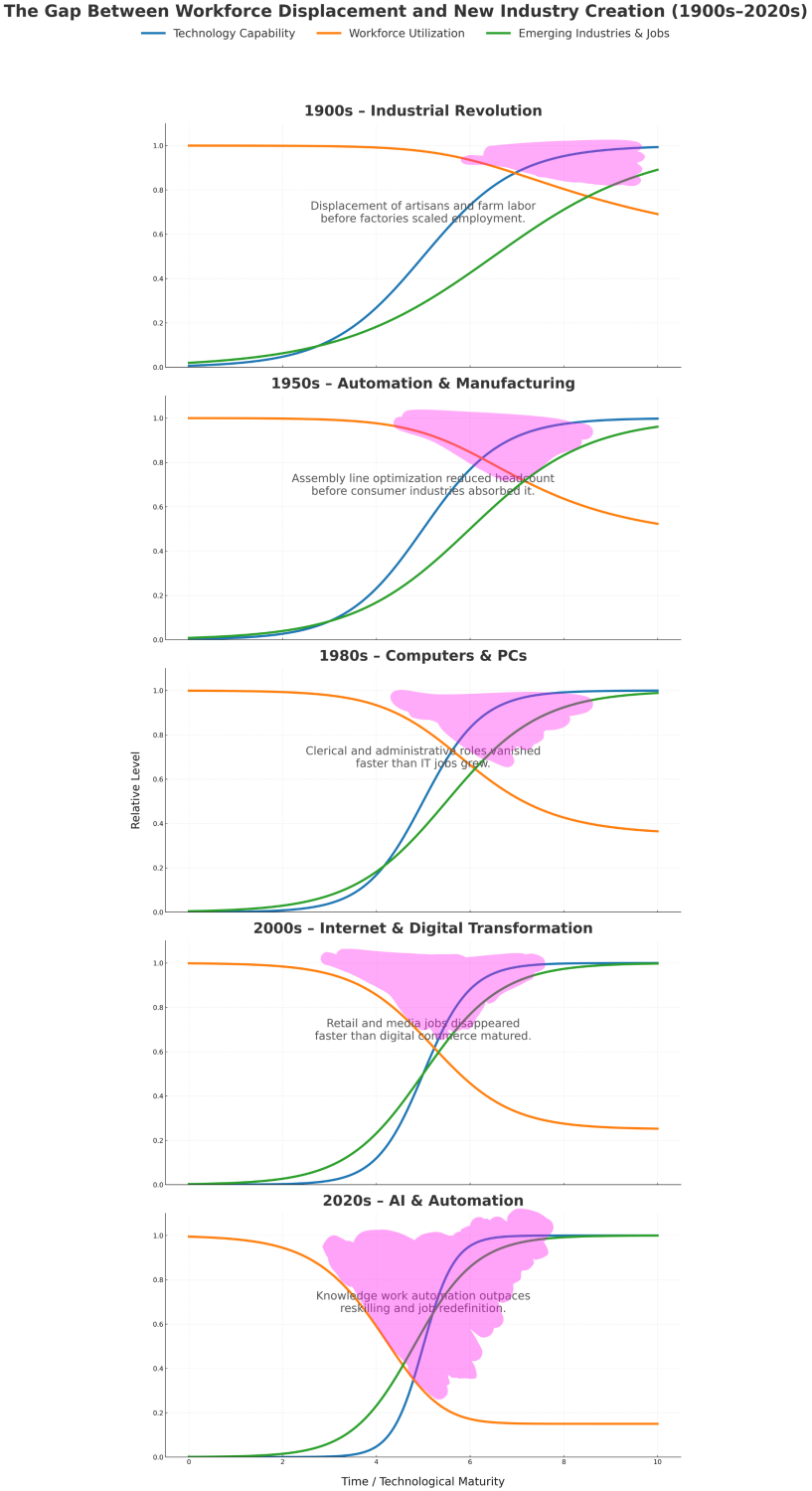
Between the orange curve of human work and the green curve of new industries lies a valley that has been growing with each technological leap – the gap between what’s lost and what hasn’t yet been created.
In the 1900s, that gap was filled with displaced artisans and farmers before factories could scale employment. In the 1950s, automation outpaced new consumer demand. In the 1980s, clerical workers were replaced faster than IT roles emerged. In the 2000s, retail and media hollowed out before e-commerce matured. And today, in the 2020s, knowledge-work automation is running ahead of reskilling and job redefinition and recreation.
While this gap has always existed, what has changed is velocity and grade of the fall. Every leap shortens the time society has to reorient. And today, AI is closing that window to near zero.
Preemptive Capital Redeployment
It doesn’t help that companies seemingly are proactively shifting investments towards CapEx under the assumption that “if we build it, they will come”.
In prior innovation cycles, investment followed demand: productivity grew first, then capacity. But in the AI economy, that order has inverted. Businesses are pouring billions into compute, chips, and cloud expansion before new industries have fully absorbed displaced workers or proven steady demand.
This proactive capital redeployment creates a paradox. The economy looks strong on paper with rising CapEx, soaring valuations, new asset classes, yet employment and wage stability lag behind. It’s a transition from human capital to machine capital, and the market hasn’t caught up to what that means for the labor curve.
The result is a widening asynchrony between growth and employment: balance sheets are scaling faster than people can retool, and investment horizons are stretching while workforce buffers are shrinking.
The Compression of Time
The problem we are seeing unravel before us is due to a healthy dose of technology innovation, workforce displacement, and timing. Every previous revolution had built-in buffers – slower diffusion, regional specialization, generational turnover. AI doesn’t wait for those because it scales instantly, everywhere, and across every vertical.
It is this compression of time that makes this era feel different. The human brain and the corporate budget cycle are both still calibrated for industrial time, not algorithmic time.
What Happens Next
The next decade won’t be defined by job loss as much as by job compression: more output, fewer roles, and a heavier premium on context, creativity, and systems thinking.
New categories of work are already forming like AI ethicists, prompt engineers, context engineers, model trainers, data-quality analysts, automation designers, agent-operations managers. But they’re still embryonic, scattered across a few forward-leaning industries and there are hundreds of other roles across all industries yet to be created.
In the near term, inequality will widen between those who learn to work with AI and those whose roles are replicated by it before they’ve mastered leveraging frontier tools to work. In the long term, the gap will close – as it always does – when new markets, tools, and cultural norms catch up. The question is this: will businesses invest to reskill their workforce for the future they themselves are creating, and will workers rise to adapt at the pace that is required for the moment?
The Business Imperative
If you lead a company, this moment demands something counterintuitive: Hire and build for agility, not just efficiency and discreet hard skills. The people who will drive value in the AI era aren’t necessarily the most technical. Rather, they’re the ones who can connect dots across systems, adapt to new tools quickly, and turn ambiguity into structure.
When you hire for someone today, you’re not hiring for the job as it is. You’re hiring for the problems your company doesn’t yet know it will need to solve. Adaptability, not headcount, is the real signal of resilience.
Your Takeaway
Layoffs mark the end of one curve, but they also mark the beginning of another. If you see them only as cost reduction, you’ll miss the strategic moment they represent which is the chance to reallocate, retrain, and rebuild for what’s next. We all grew up being taught that being a sharp scalpel was better than a dull Swiss Army knife. But looking ahead, the moment now demands a sharp Swiss Army knife that has a scalpel built in. Are you here for it?
 Annie Tsai
Comment On This Post: